What Is a Knowledge Graph? (And What It Means for Your Business Data)
A Knowledge Graph maps the relationships between every entity across all your connected systems. Here is what that means in plain terms and why it matters for decisions.
What Is a Knowledge Graph?
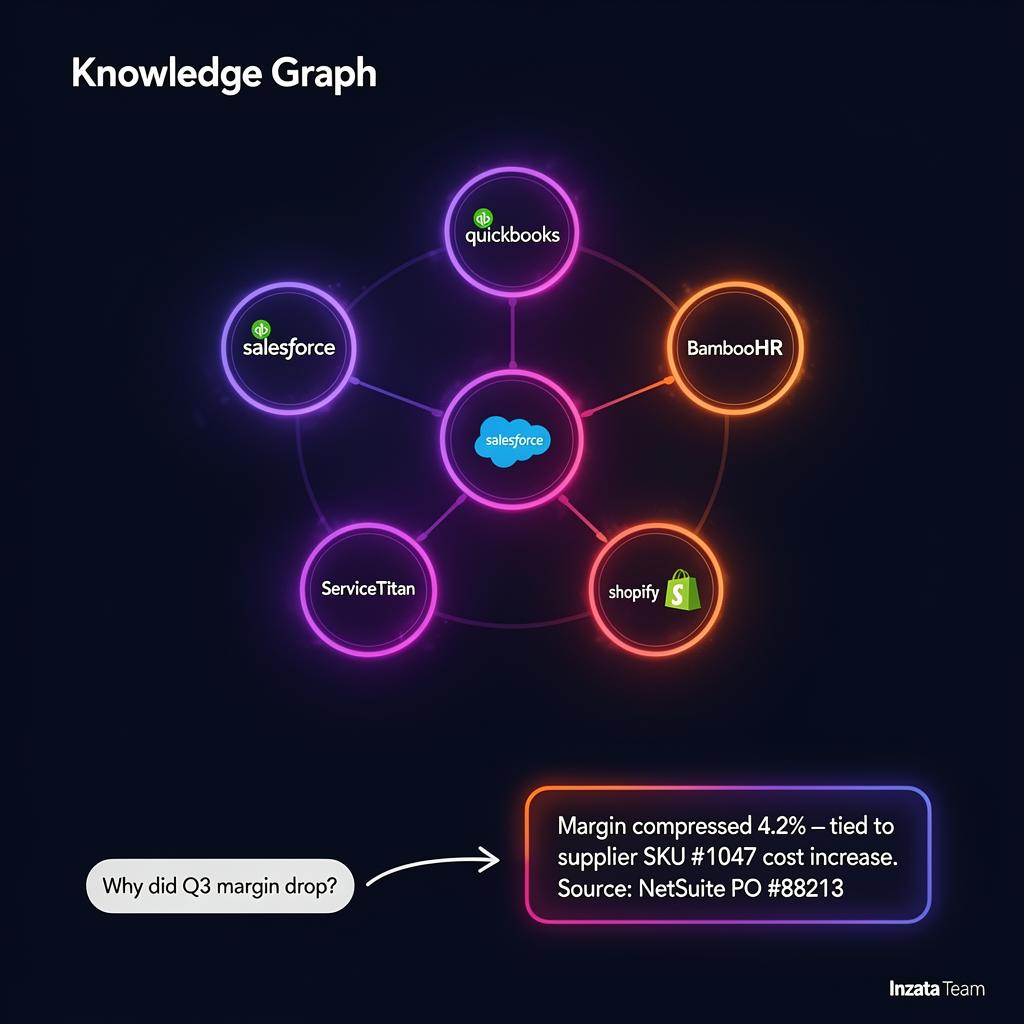
A Knowledge Graph is a map of every entity in your business and the relationships between them.
An entity is any meaningful thing: a customer, a product, an invoice, a supplier, an employee, a transaction. A relationship is how those things connect: this customer bought this product, this invoice came from this supplier, this employee manages this account.
A standard database stores rows and columns. It answers one question at a time and only within its own schema.
A Knowledge Graph stores entities and relationships. It answers questions that span multiple systems simultaneously, because it knows how everything connects.
Why Relationships Are the Missing Layer
Most business questions cannot be answered from a single system.
"Why did gross margin drop last quarter?" Lives across your ERP, your supplier contracts, your CRM deal data, and your inventory system. None of those systems know what the others contain.
"Which customers are most at risk this month?" Lives across your CRM, your support tickets, your billing system, and your product usage logs.
"If we lose our largest supplier, what breaks first?" Lives across your procurement data, your inventory levels, your open orders, and your sales pipeline.
A Knowledge Graph connects all of those sources. It maps the relationships automatically. It does not require a data engineer to define a schema or a BI analyst to build a join. The graph builds itself from the connected sources.
How a Knowledge Graph Builds Itself
DataBlueprint connects to your systems read-only. No write access. No schema changes. No data migration.
Once connected, the platform performs automatic entity resolution: it recognizes that "Acme Corp" in your CRM and "Acme Corporation" in your QuickBooks are the same entity. It maps relationships across sources without being told what to look for.
The result is a living graph that updates as your data updates. Not a static snapshot. Not a quarterly export. A continuously synced model of your entire business.
What You Can Do With It
Once the Knowledge Graph exists, a private LLM powered by AWS Bedrock sits on top of it and answers questions in plain English.
You ask: "What is driving the gap between our Q3 forecast and actual revenue?"
The system queries the graph across your CRM pipeline data, your GL, your invoicing system, and your deal notes. It returns an answer in plain English, sourced to the exact rows and documents it used to generate it.
You do not get a dashboard to interpret. You get an answer with evidence.
What a Knowledge Graph Is Not
A Knowledge Graph is not a data warehouse. It does not store copies of your data. It connects to your existing systems and reads them.
It is not an ETL tool. It does not move data between systems. It does not replace your operational software.
It is not a generic AI chatbot. The answers it gives are grounded in your actual data. Every answer is traceable to a specific row, document, and system. No hallucinations. No probabilistic guesses.
How Long It Takes
The first connection takes under 10 minutes. Full deployment across 15 to 40 systems takes one to five business days. No IT ticket required. No schema changes. No data migration.
DataBlueprint supports 800+ connectors across ERP, CRM, HR, finance, databases, and cloud storage. If your business runs on it, DataBlueprint connects to it.
The Bottom Line
Your answers are trapped because your systems do not talk to each other. A Knowledge Graph is what makes them talk.
Not by moving your data. Not by replacing your software. By mapping the relationships that already exist and making them queryable in plain English.
That is what DataBlueprint builds. Automatically. In minutes.
Frequently Asked Questions
What Is a Knowledge Graph?
A Knowledge Graph is a map of every entity in your business and the relationships between them. An entity is any meaningful thing: a customer, a product, an invoice, a supplier, an employee, a transaction. A relationship is how those things connect: this customer bought this product, this invoice came from this supplier, this employee manages this account. A standard database stores rows and columns. It answers one question at a time and only within its own schema. A Knowledge Graph stores entities and relationships. It answers questions that span multiple systems simultaneously, because it knows how everything connects. ---